Is the Doctor in?
Rural medicine in remote communities was often reliant on “old wives’ tales”, herbs and roots, and other “remedies”, including whisky.
The Medical profession has changed as much, if not more, than any other profession. In the early days the doctor was the lifeline of the entire family. He was the dispenser of medicine, diagnostician, surgeon, counselor, adviser, and confidant. Hippocrates once said that “some patients, though conscious that their condition is perilous, recover their health simply through their contentment with the goodness of their physician.”
As late as the 1920’s there were cases of kitchen table surgery by lamp light, mid-wivery or un-attended births, communicable diseases raging rampant, herbal medicines, and few tools of the trade in rural areas. Many of the doctors had two professions because their medical practice did not pay well enough to meet the needs of their families.
A fascinating read about early doctors in Sevierville, TN (in the heart of the Smoky Mountains), compiles the stories of early doctors in this mountainous region. Here are just a few of these accounts that provide a glimpse of what Dr. Neil MacNeill faced at Cutter Gap:
Dr. Bradshaw – As a practicing physician Dr. Bradshaw had sympathy for all suffering humanity. Many times as the cold winds blew and the rain came down, in the dark of night he saddled his horse and rode out to minister to the sick, knowing in many cases he would receive no recompense. After having the flu himself, he went out to visit patients and contracted pneumonia, which led to his death [in 1911].
Dr. Charles Henry Hoffman did an internship and residency at Bellevue, New York City, He later went to Montana to practice surgery. While there, he and a physician friend bought a sheep ranch. One cold wintry day he was out on his horse rounding up the sheep when his horse threw him. His right knee was broken so he had to lie in the cold until his friend found him. During this ordeal, his right hand was frostbitten and he had to have two fingers removed-thus ending his surgery practice.
Sometime later, Dr. Hoffman left Montana and became a member of the faculty of Arkansas Medical School where he taught anatomy and surgery. In the summer of 1913 he went to North Carolina to relieve a physician friend who had to undergo surgery. While there he fell in love with the mountains of North Carolina and Tennessee.
The mountain people soon found out that there was a physician in their midst and began to calI on him to see the sick. Everyday he became more involved with the medical emergencies in this isolated area. . .and decided to stay.
Dr. Hoffman called on his friends, Dr. John W. Rogers of Sevierville, and Dr. William Lynn of Knoxville, to help with emergency “kitchen table” surgery. He delivered many babies, some with the help of his wife. For his services he would receive corn, potatoes, vegetables, etc. For the people who were unable to pay, and the family needed the food, Dr. Hoffman would accept nothing for his work.
Most of Dr. Hoffman’s 36 years of service were spent in the mountains. If he could not get to the homes by car, he rode horseback in all kinds of weather, under difficult circumstances. Many times, it was necessary for him to be up night and day visiting patients in Cosby, Pittman Center, Copeland, Jones Cove, Gatlinburg, Sugarlands, Elkmont, and Townsend. He would come home many winter evenings with his feet frozen in the stirrups of his saddle from crossing rivers on his horse, and his wife would have to take a stick of stove wood to loosen his feet from the stirrups.
Dr. John Wright Rogers
He stayed in Blount County until 1912 when he setup practice in Sevier County. He owned the first stethoscope in Sevierville, kept a human skeleton (Mr. Bones) in his office, and had an ultra violet ray machine, said to be good for arthritis. Dr. Rogers had typhoid as a young man, so he did not believe in starving a fever. He gave his patients small amounts of high calorie foods which were easily digested with striking results. During the smallpox epidemic in Sevierville, he kept a raincoat in his car to put on before visiting his patients. He worked many, many hours during the flu epidemic during World War I. Dr. Rogers rode horseback, or in a buggy to make house calls before he got his Ford Runabout. He always kept one or more horses in the barn. His riding horse was always called “Dandy” regardless of its name before he got it.
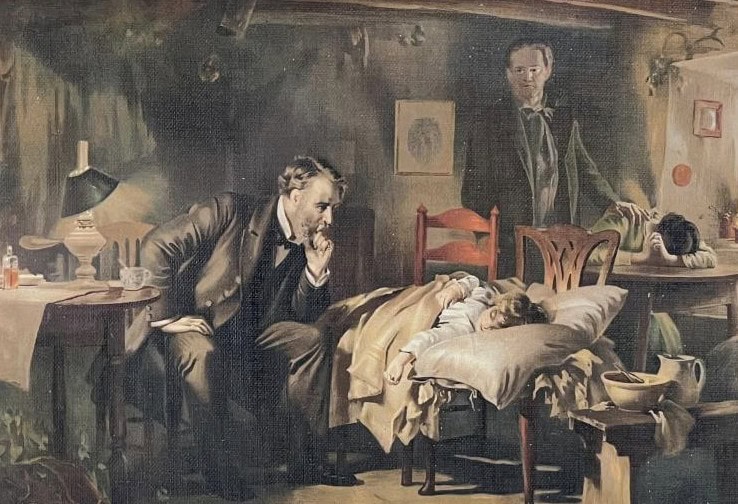
- Fildes was inspired to create the scene after experiencing the tragic loss of his own son to typhoid fever and witnessing the compassionate care of the attending doctor.
- It became an iconic symbol of caring medical practice and was famously used by the American Medical Association in campaigns during the mid-20th century.
Image: Reproduction of “The Doctor” (1891) by English artist Sir Luke Fildes.
Research: Some Early Sevier County Doctors