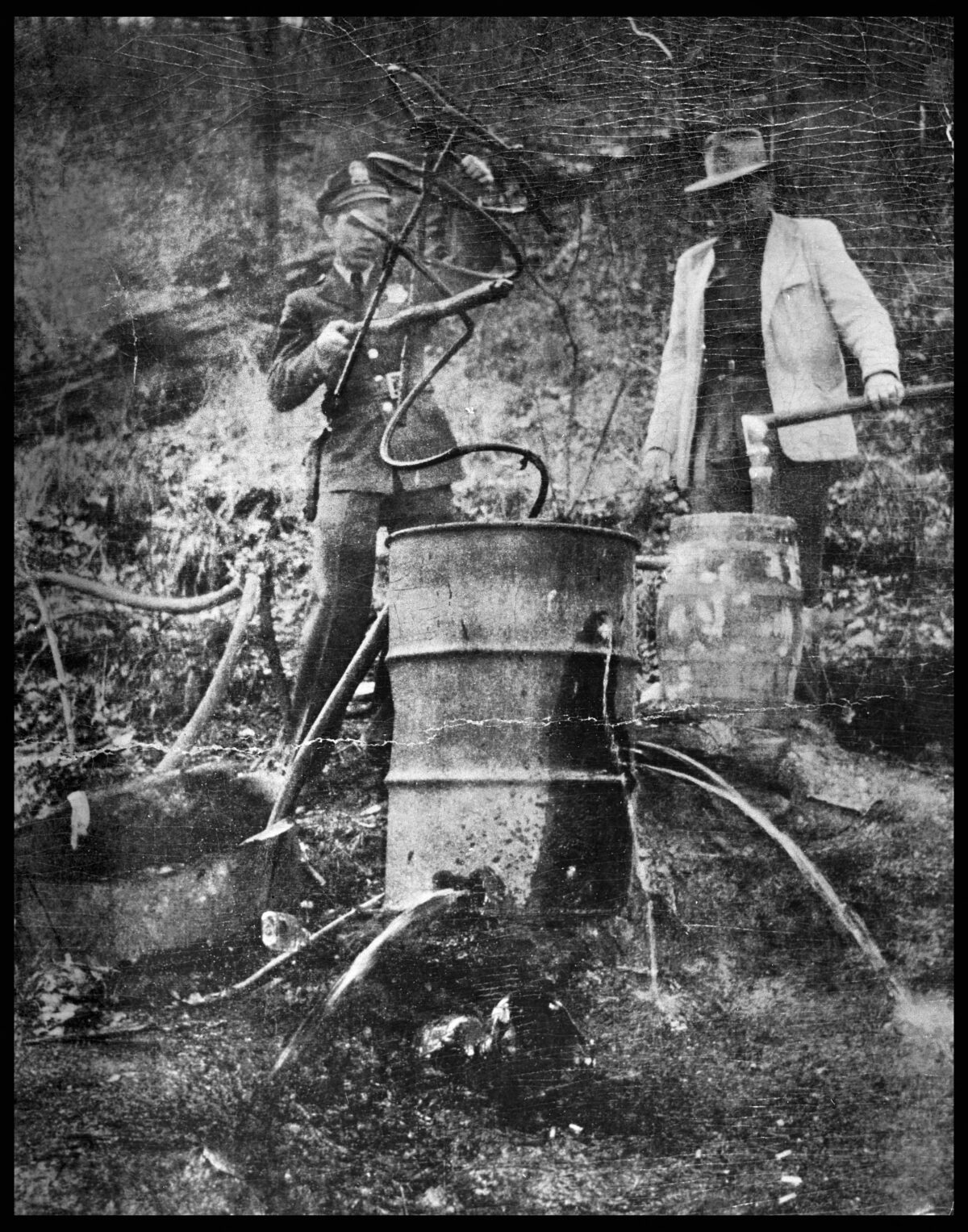
Moonshine – Mountain Men v. Government Men
Simply stated, “moonshine” is untaxed liquor, furtively produced quite often by the light of the moon, or at least out of the immediate reach and oversight of law enforcement. Nicknamed “corn likker,” “white lightning,” “white mule,” “mountain dew,” and numerous other local appellations, the typical moonshine is clear in color and potent, usually approaching 100 proof, or 50 percent alcohol by volume
The process of making moonshine includes fermentation, distillation, and condensation. The basic ingredients are sugar, water, yeast, cornmeal, and malt. First the mash of fermented grain is carefully heated. At the conclusion of the process, the alcohol is condensed, using the “worm,” a coil of copper pipe in a barrel of cool water. Although the process appears to be a simple one, only well-trained and highly skilled practitioners can produce unadulterated whiskey under such generally primitive conditions. Scots-Irish settlers brought with them to America the knowledge and skills of whiskey-making. . .
The legal history of this cottage industry followed several trends. Between 1817, when the excise tax was lifted, and 1862, when it was reinstituted, local distillers flourished along with larger established companies. In 1878 the federal government offered a blanket pardon to moonshiners, which many accepted while still plying their trade. The Tennessee v. Davis Supreme Court decision of 1879 established federal supremacy in moonshine prosecution cases.
With corn the primary crop, particularly among semisubsistence farmers in the Appalachian backcountry, it was only natural for the production of distilled liquor to become the occupation or avocation of many farmers. Coupled with poor or corrupt local law enforcement and inhospitality to federal “revenuers,” a tradition was formed that would last to the present.
Several areas in Tennessee, particularly Cades Cove, and Blount, Carter, Fentress, Hancock, Henry, Polk, and Scott Counties, have dominated the history of moonshining in the state.
[NOTE: Cades Cove is part of the Smoky Mountains and 11 miles south of Townsend, TN – close to the Ebenezer Mission, the site of Christy]
Women as well as men took part in the trade. For example, Mollie Miller led the moonshiners of Polk County and has been credited for the killing of several revenuers and informants. Another woman, who reportedly weighed six hundred pounds, ran a bloody family business, comforted by the fact that lawmen could think of no way to physically transport her to the seat of justice.
The folklore and legends about moonshiners and revenuers have become a lasting part of southern history. The blockade runner, or “tripper,” became legendary with the advent of fast, modern automobiles. Their flights from justice stood them well as a training ground for developing proficiency in high-speed driving, and many runners became contenders on the early stock car circuit. Revenuers who served as the nemesis of their moonshining quarry became famous as well.
The cause of many well-known and countless lesser known crimes of passion, as well as times of pleasure, the moonshine trade is perhaps best described by the following verses from an old mountain folksong: “You just lay there by the juniper / When the moon is bright / And watch them jugs a-fillin’ / By the pale moonlight.”
— Excerpted from Moonshine by William E. Ellis, published by Tennessee Historical Society (2017, updated 2018)